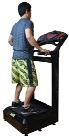

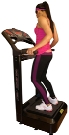

The Theory behind Vibration Therapy
History and the Current Understanding of
Vibration Therapy
The use of vibration, as a therapy method,
has been attempted in one form or another since the time of the
ancient Greeks. In the late 1900s, whole body vibration
(WBV) received serious attention as a possible means of
reducing the detrimental effects, particularly of bone loss,
during spaceflight (see NASA Article).
Thanks to extensive investigation
concerning vibration in the workplace environment, such as when
operating heavy machinery, standards for exposure to whole body
vibration in industrial settings have been well-established.
(Refer to ISO standards (ISO 2631) (8, 14, 22))
The use of vibration therapy for
therapeutic purposes has been studied more recently for many
reasons. Most every study recommends that more studies
take place in order to understand the treatment more
thoroughly. Researchers are (justifiably) conservative in
making claims as to how the findings based on a small group can
be applied broadly to the human population. Good Vibrations 4
Life Inc. offers the following links for your
information. Studies related
to: Athletic Performance, General Interest, Osteoporosis & Age-Related
Concerns, Rehabilitation.
This is by no means a complete list.
Please refer to current scientific journals and the
Internet for further studies.
Good Vibrations 4 Life Inc. agrees that
more research and investigation into the benefits of whole body
vibration is desirable. However, given that the treatment
has been clearly successful in many cases, Good Vibrations 4
Life Inc. stands behind the use of its WBV equipment as a means
of achieving a variety of health benefits, without fear of
injury, as long as the equipment is used within the recommended
safe guidelines.
More important than anything else, in
response to today's society's enormous health challenges, we
stand behind this philosophy:
"Any safe form of exercise is
immensely better than no exercise at all."
Vertical Vibration or Oscillating
Vibration, What's the Difference?
In the case of vertical (simultaneous)
vibration, an upward force is applied to both the right and
left sides of the foot plate (the entire plate) at once.
In the case of oscillating vibration (rotating
vibration), force is applied to one side at a time only, with
the plate "rotating" around a central axis.
Vertical vibration machines are normally operated at a
lower amplitude, but a higher frequency, in order to achieve
their effect.
Good vibrations presents the oscillating
vibration stimulus of the GVM TM as a more natural stimulus. The forces
directed toward the legs, hips and spinal column are similar to
those the body experiences in the course of walking.
Walking is perhaps the most natural movement engaged in
by the human body involving large muscle groups.
While the effects realized by the many
vertical vibration machines can be appreciated, treatment often
requires going into the realm of unsafe frequency levels by ISO
standards. (Equal to or greater than 30 hertz).
Good vibrations strongly suggests use of
the GVM
TM as a safer method of benefiting from the WBV
effect.
Vibration therapy affects muscles and
bones by eliciting a response based on a stimulus. In the
case of the GVM TM, that stimulus is both vertical and horizontal,
Vertical forces cause the body to experience a greater force
than it would standing still, comparable to performing
exercise. That force is measured as a factor of G, the
force of gravity normally acting on the body. G force
causes a healthy response in bone to develop mass and structure
in order to withstand the forces applied to it.
Horizontal forces cause the body to shift
in posture from a state of equilibrium to a state of
disequilibrium. In state of disequilibrium, the human
body responds automatically, below the level of consciousness,
by way of reflexes and other neurological pathways, those that
allow us to stand straight and balance without thinking about
it. This response strives, by way of nerves acting on muscles,
as quickly as possible, to return the body to a state of
equilibrium. The vibration forces induced by the GVM TM cause
the muscles of the body to repeatedly act and then act again,
many times per second, to reestablish equilibrium, thereby
giving healthy exercise to muscles and bones.
Due to a physiological concept known as
the stretch reflex,
muscles receive additional stimulation as a result of vibration
therapy. When a muscle is in the midst of a contraction,
as it is on the GVM TM, due to an upset in the body's state of
equilibrium and, while in that state of contraction, it is
subjected to another force, a compounding effect is achieved.
Muscles and tendons, when stretched, receive additional
nerve input to contract further. This is a normal
response that can be witnessed in the typical knee-jerk reflex test. This reflex exists in order to prevent damage to
muscles from overstretching. The fitness benefit is that
vibration therapy can, by this method, achieve a greater
recruitment of muscle fibers than can be achieved by normal
conscious efforts. This phenomenon has been utilized in
the pursuit of peak athletic performance in a practice known as
plyometrics.
Based on the effects of bone and muscle
stimulation, many other naturally occurring effects can be
achieved. These are primarily based on circulation, which
is greatly increased in both the circulatory and lymphatic systems, whenever muscular contraction occurs. With
that circulation comes the oxygenation of tissues, the delivery
of nutrients to them, and the removal of toxins, waste and
other undesirable substances - an indisputable benefit from
many health-related points of view, including immune response
and disease prevention.
Under heavy load (weight training, for
example), muscles will experience a burning sensation.
This is based on a natural accumulation of the waste
products of muscular metabolism (lactic acid, in particular).
That is why vibration therapy on the GVM TM, at lower
frequencies, is a desirable way of finishing a work out. The
delivery of oxygen and nutrients, and the removal of
accumulated metabolites, is the likely reason why less
post-workout muscle soreness, and faster recovery, can be
experienced after a warmdown session on the GVM TM. (See studies
related to athletic performance)
Other benefits, such as weight loss,
stress relief and a general feeling of well-being, can be
expected to result, just as they would from the practice of
other forms of regular exercise. The primary benefit of
the GVM
TM, in this regard, is that it makes regular exercise
highly accessible and efficient.
How Much Vibration Is Required?
The vibration effect is a matter of
frequency, duration and amplitude.
Frequency is a matter of cycles per
second, which should, based on ISO standards, be kept below 30
hertz.
Duration is a matter of time available,
and, given the need to conserve time in today's society, that
time is desired to be minimal. The minimal time also
prevents any undesirable effects of exposure to vibration over
time from materializing. A reasonable amount of time is
judged to be 10 to 15 minutes - long enough for a person to
feel that exercise is being achieved, without being
unreasonably demanding.
Amplitude is a matter of a compromise
between what is needed to create the exercise effect (the G
force, for example) and that which can be pleasantly
experienced by the human body. In the case of vertical
vibration machines, amplitude is kept quite low, (less than 5
mm, for example) to prevent the experience from being too
unpleasant. Unfortunately vertical vibration, therefore,
requires operation at a higher frequency, which can push it out
of the realm of safe exposure. In the case of an
oscillating vibration machine, such as the GVM TM, the human
body can safely enjoy a benefit from a greater amplitude, such
as 12 mm. Because of the greater amplitude, frequencies
of 30 hertz or more are not necessary .
By these means, a reasonable daily
routine, to provide muscle stimulation and bone maintenance,
can be achieved by spending 10 minutes per day, at a frequency
of 12 hertz and an amplitude of 5 mm (feet placed halfway
between the center and the side edge of the foot plate) on the GVM TM.
To provide more muscle stimulation, to
burn more calories or create a greater fitness effect, several
options are available:
1. The position of the feet can be shifted
slightly outward on the foot plate to increase the amplitude
toward 10 mm.
2. The frequency can be gradually
increased toward 15 to 20 hertz.
3. The duration can be increased slightly,
toward 15 minutes per session or to two 10 minute sessions per
day,
Please note: Some improvements due to WBV
may be noticed quickly (within a few sessions), such as
increases in muscular endurance. Most measurable
improvements take at least several weeks to occur.
Others, such as increases in bone mass and density, may
take 6 to 8 months of WBV in order to have their effect (Refer to studies above).
